

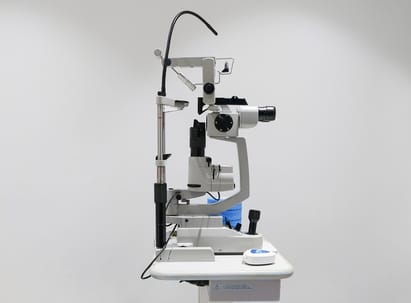
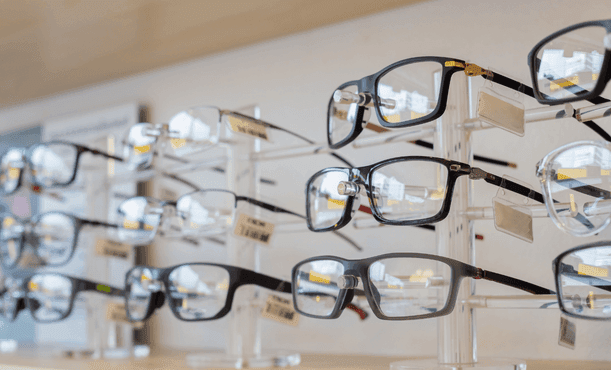
Your Visual Specialist
The Optikid
Our Expertise
- Visual problems in both children and adults
- Planning for the prevention and management of myopia progression in children
- Monitoring treatment outcomes through refraction and examinations by an ophthalmologist, measuring axial length and corneal power with a refractive surgery grade optical biometer.
- Consultation on refractive surgeries, including PRK, LASIK, ReLEX SMILE/KLEX, Phakic IOL (ICL), and cataract surgery.
- Visual problems in both children and adults
- Planning for the prevention and management of myopia progression in children
- Monitoring treatment outcomes through refraction and examinations by an ophthalmologist, measuring axial length and corneal power with a refractive surgery grade optical biometer.
- Consultation on refractive surgeries, including PRK, LASIK, ReLEX SMILE/KLEX, Phakic IOL (ICL), and cataract surgery.
Our Services
What Service We Offer


Children's Eye Health Check-up Programme (With Accommodation-Relaxing and Pupil Dilation Drops)







Children's Eye Health Check-up Programme (With Accommodation-Relaxing and Pupil Dilation Drops)
Why Us?
We offer a complete range of optometry and eye care services.
The Optikid has specialists in various fields, corresponding to vision problems from childhood to adulthood. We can provide advice and treatment ranging from adjusting visual habits, using spectacles or contact lenses, to consulting on refractive surgeries such as PRK, LASIK, ReLEX SMILE (KLEX), Phakic IOLs (ICL), or cataract surgery.
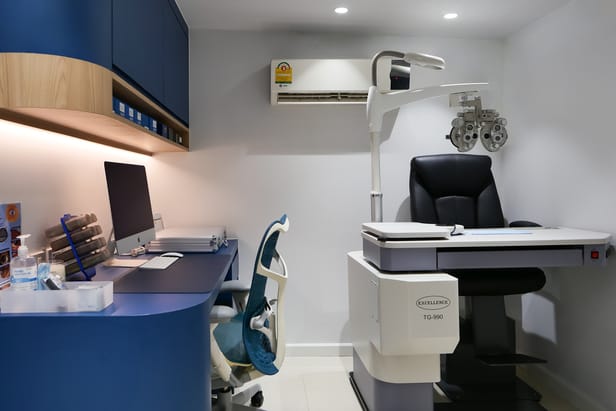
Children's Myopia Risk Assessment
To assess myopia risk for good eye health and for timely prevention or slowing of myopia progression. This assessment will help check your eye health risk.
This assessment will help check your eye health risk.
📋 Step 1 – Risk from Refraction by Age (Premyopia)
🧬 Step 2 – Risk from Genetic Factors
👀 Step 3 – Risk from Visual Activity
☀️ Step 4 – Risk from Lack of Natural Sunlight
✍️ Step 5 – Contact Information
Our Team
Our Experts



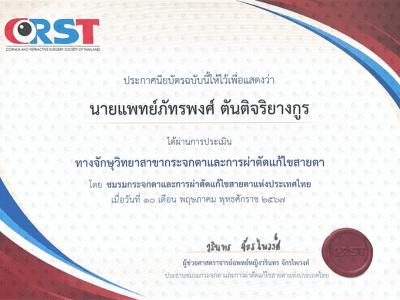
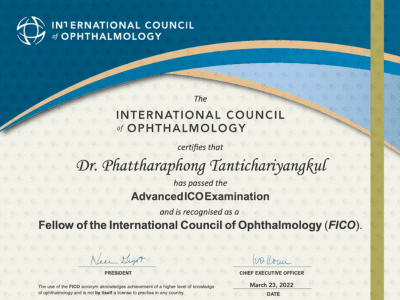
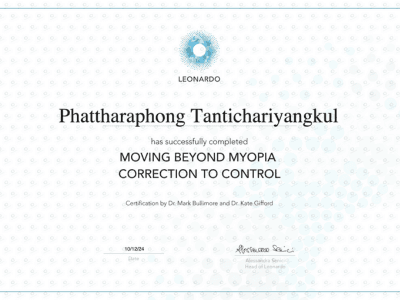
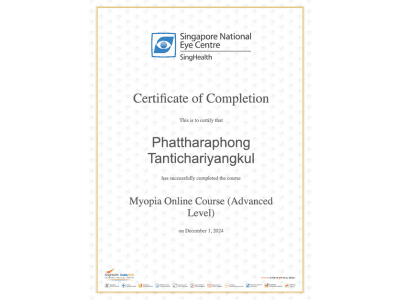
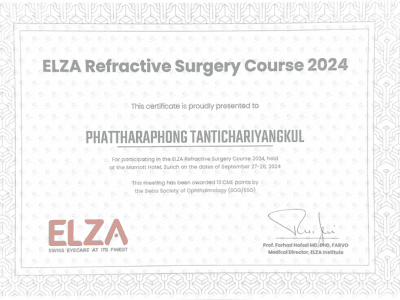
Phattharaphong Tantichariyangkul, MD, FICO
Phawasutthi Keokajee, MD
Ophthalmologist specialising in Paediatric Ophthalmology and Strabismus
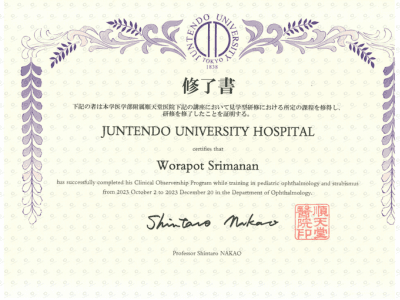
Asst. Prof. Worapot Srimanan, MD
Ophthalmologist specialising in Paediatric Ophthalmology, Strabismus, and Neuro-ophthalmology

Phattharaphong Tantichariyangkul, MD, FICO
Ophthalmologist specialising in Cornea and Refractive Surgery
[Read More]
Phawasutthi Keokajee, MD
Ophthalmologist specialising in Paediatric Ophthalmology and Strabismus
Asst. Prof. Worapot Srimanan, MD
Ophthalmologist specialising in Paediatric Ophthalmology, Strabismus, and Neuro-ophthalmology

Our Blog
Knowledge & News
Our Blog
Knowledge & News
FAQ
Frequently Asked Question
How should I prepare if I want to bring my child for an eye examination?
For a vision test, accommodation-relaxing and pupil-dilating drops may be used. This will cause blurry near vision and light sensitivity for 1-2 days. Therefore, you should avoid scheduling an examination right before school exams. If you have sunglasses, it is recommended to bring them. For young children who cannot yet read numbers, we recommend practicing with an Allen chart (picture chart) at home to facilitate the visual acuity test.
At what age can I bring my child for an examination?
- If abnormalities are noticed: Bring them in immediately. Examples include observing crossed eyes (strabismus), frequent head tilting, squinting, walking very close to the television, frequent blinking, frequent eye rubbing, light sensitivity, noticing a white appearance in the pupil, or difficulty seeing the blackboard/whiteboard.
- For a general eye health check-up: You can bring your child starting from 1 year of age.
- For a vision test: We recommend starting from 3 years of age. Children at high risk for vision problems (e.g., having short-sighted parents or being born prematurely) should be examined at an early age.
If my child always passes the school vision screening, should they still have a comprehensive eye exam?
Yes. If the school screening only tests visual acuity and refractive error, they should still have a comprehensive eye health examination with an ophthalmologist. This is especially important before ages 8-10, when the visual system is fully developed. If amblyopia (lazy eye) is present, it responds much less to treatment after this age.
From what age can one undergo refractive surgery, such as LASIK?
Generally, refractive surgery is performed on individuals aged 18 or older. Additionally, the candidate’s prescription must have been stable (not increased) for at least one year, and their cornea must be sufficiently thick and healthy.
If my child has never had an eye exam, can we wait until they are old enough for LASIK or refractive surgery?
You should not wait. Waiting until the age for surgery may allow permanent, untreatable conditions to develop, such as amblyopia (lazy eye). It also ignores the risks associated with unmanaged high myopia, such as retinal detachment, glaucoma, cataracts, and macular degeneration. Furthermore, uncorrected vision often leads to an unstable prescription, which would make the child ineligible for surgery, or their prescription may become too high to be fully corrected by surgery.

Happy Patients
Make An Appointment