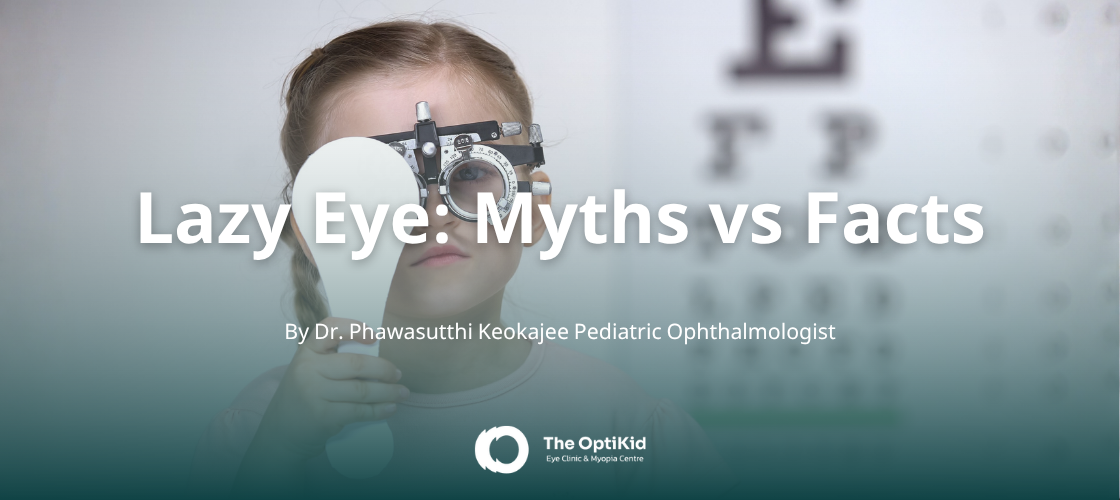
Many people have heard the term “Lazy Eye,” but there is often confusion about what it actually is and how it’s treated. Understanding this condition early is vital because the window for treatment closes as a child grows.
What exactly is a Lazy Eye?
Lazy Eye (Amblyopia) is a vision development disorder that begins in childhood. It is not simply “bad vision” that happens to adults. From birth until age 8-10, a child’s brain is learning how to process images from the eyes. If that development is interrupted, it can lead to permanent vision loss. The Definition: Amblyopia occurs when the brain fails to process inputs from one (or both) eyes correctly, even after issues like refractive errors (glasses) or physical blockages are fixed. If a child sees clearly once they put on glasses, they do not have a lazy eye.
Common Causes & Misunderstandings
| CAUSE | THE MYTH | THE FACT |
| Refractive Errors | Adults with one weak eye are often told they have a “lazy eye.” | Only true if vision loss happened during childhood. |
| Strabismus | It is a “Lazy Eye Muscle.” | There is no “lazy muscle”; the brain simply stops using that eye. |
| Physical Obstructions | Babies with cataracts will definitely have a lazy eye. | Early surgery (first 3 months) can lead to $20/20$ vision. |
A. Refractive Errors (Nearsighted, Farsighted, or Astigmatism)
When one eye has a much higher prescription than the other, the brain “competes” and eventually chooses to ignore the blurrier image, stopping its development.
The Myth: If an adult has one weak eye and glasses don’t make it 100% clear, they are often told they have a “lazy eye.”
The Fact: This is only true if the vision loss happened during childhood development. In adults, if the eye was once healthy, it isn’t technically “lazy.”
B. Strabismus (Misaligned Eyes)
This occurs when the eyes don’t work together—one may turn in, out, up, or down. The brain suppresses the image from the turned eye to avoid double vision.
The Myth: Parents often think “Lazy Eye” and “Crossed Eyes” are the same thing, or call it “Lazy Eye Muscle.”
The Fact: Strabismus is either a cause or a consequence, not the condition itself. There is no such thing as a “lazy muscle”; rather, the vision becomes lazy or the eye becomes deviated because the brain stops using that eye.
C. Physical Obstructions (Deprivation)
Anything that blocks light from entering the eye like a droopy eyelid (Ptosis) or childhood cataracts, can cause severe amblyopia.
The Myth: A baby born with a cataract will definitely have a lazy eye.
The Fact: If caught and surgery is performed very early (especially in the first 3 months), the eye can often develop $20/20$ vision!
How Do We Treat It?
Treatment follows two main steps:
- Fix the Root Cause: Provide the right glasses, perform surgery for cataracts, or align the eyes through muscle surgery.
- Stimulate the “Lazy” Eye: We force the brain to use the weaker eye. This is done by:
- Patching: Covering the “good” eye for several hours a day.
- Eye Drops: Using special drops to temporarily blur the good eye.
- Vision Therapy: Engaging in specific exercises or games designed to stimulate visual processing.
Doctor's Advice for Parents
Amblyopia is preventable, but timing is everything. Once a child passes age 8-10, the brain’s visual wiring is mostly permanent. Watch for these signs in your child:
- Droopy eyelids or “white” reflection in the pupil.
- Eyes that don’t look in the same direction.
- Squinting, tilting the head, or sitting very close to the TV.
- Closing one eye to see better.
The Golden Rule: Every child should have a comprehensive eye exam before age 7 to ensure they have a lifetime of clear sight.

Dr. Phawasutthi Keokajee
Pediatric Ophthalmologist